A Family History
By Wilma (Van Keuren) Billups
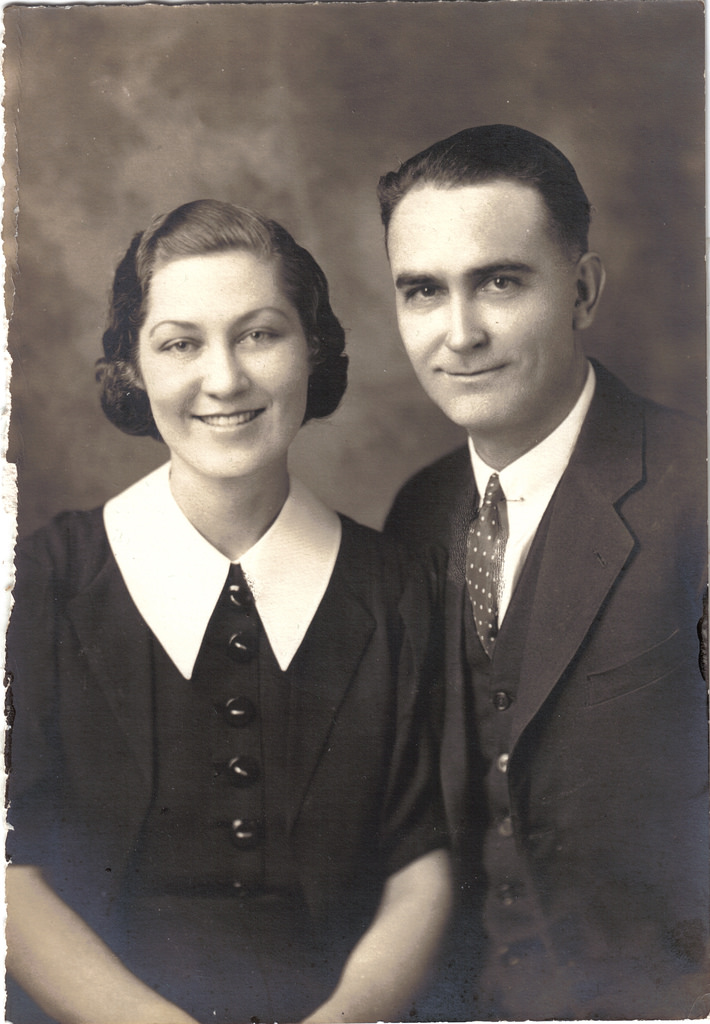
Clarence and Amanda Howard
| Clarence Howard | Amanda Jane Dale |
| Born August 9, 1849 in Middleton, Ohio |
Born January 7, 1854 in Mahomet, Illinois |
| Married Nov. 15, 1874 in Mahomet, Illinois | |
| Died April 6, 1931 in Hutchinson, Kansas |
Died November 13, 1932 in Hutchinson, Kansas |
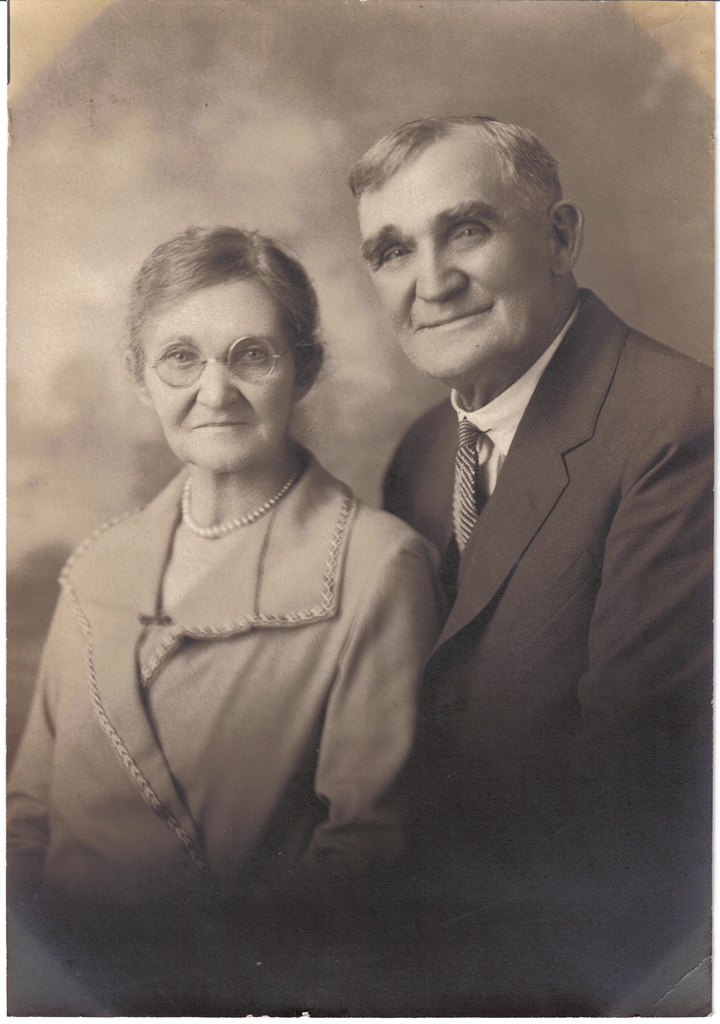
Clarence and Amanda Howard, on their 50th wedding anniversary in 1924
As Clarence first stepped from the wagon in Kansas, a rattlesnake bit him on his right thumb. An old fellow nearby slit the bite and sucked out the poison as best he could. Granddad had a bent thumb after that and it was just right to catch you by the ear and make you dance. He loved to take some of us by surprise and hear us yell. This was always as a joke, as he was a gentle man.
Homesteading didn't work out in Russell County and they moved to Emporia in Eastern Kansas. There was work there for an experienced stone mason, as Clarence was, and the climate was better. It was in Emporia that their other children were born: Orval in 1880, Ora in 1882, Harry in 1884, and Zona in 1886.
The family lived in Olath a short time and then moved to Kansas City where the children went to school and considered their home as they made many friends and enjoyed the big city.
In 1899, Clarence took a position as an officer at the Kansas State Reformatory in Hutchinson, Kansas. He was in charge of building the huge stone wall to enclose the prison. He also designed the stone towers for the guards to keep watch over the entire prison and built several of the office and cell block buildings.
After this work was finished he decided to start his own cement and contracting business. There are sidewalks still in use with the names Howard-Son and Van Keuren imprinted on them. The son was Harry, an expert cement finisher, and Will Van Keuren was his son-in-law. He had a mold for making vases and bases; many are still in use in the Eastside Cemetery and at homes over the town. One is presently at the home of a great-grandson, Kenneth Billups, in Pueblo, Colorado. He invented and patented a waterproof cement vault known as the Howard Burial Vault. He sold many in Hutchinson and nearby towns. For years he had a display at the Kansas State Fair held in Hutchinson each September. An eastern vault company offered him $10,000.00 for the patent but he would not sell. He later said he thought that they would make a better offer, but he did not hear from them again. The last two vaults he made were used for his and my grandmother's burials.
Amanda became asthmatic after her last child was born and never regained full health. Despite this they were active members and faithful attendants at Hadley Methodist Church.
Amanda did some crocheting and made beautiful tatting and embroidery. But as with most women of her day, the family and home were her main concerns.
They celebrated their 50th wedding anniversary November 15, 1924. This was unusual in those days, as not many reached so many years together. There was a big celebration and open house for relatives and friends. Their picture was in the Wichita paper, considered quite the "thing" in those days. Amanda's dress was a beautiful pale gray gabardine trimmed in silver bugle beads made by her daughter Gertie Van Keuren.
Clarence and Amanda are buried in Eastside Cemetery. Their daughter Ora Might is also on the same lot. In about 1970 the curbings Granddad had put around the lots were taken out in order to use a riding lawn mover to cut the grass. Until then each family had been responsible for care of his lot.
Most of the above has been written from records and clippings kept by my mother Gertie Howard Van Keuren.
I have tried to include some of the events and memories I have of my grandparents. I want future generations to know them as more than just statistics. They were happy and loved by many.
One time when I was very small I asked my grandpa what made the holes in the huge blocks of stone in the Reformatory Wall. He told me they were made by special worms that were very scarce and had to be brought to Kansas for that purpose. I believed him and it was a long time before he explained they were bored into the stones to make it possible for the big tongs to be inserted into the holes and then lifted into place.
For years all the relatives tried to be at our grandparents for Thanksgiving and especially the Christmas holidays. It was one of the few times those out of town could be there and I loved the excitement. Later I learned how lucky we children were because grandma always fixed a special table in the kitchen for the kids, so we did not wait to eat until the grownups were finished; since they liked to sit around and visit after eating it would have been a long wait. My husband Bert Billups told me that many times it would be late afternoon before the kids could eat at their family gatherings.
Although Grandma was never very well she always had pie or cookies on hand. In the summer she kept lemonade in the icebox. This was a real treat in the days before electric refrigeration when most people did not keep cold drinks on hand. Also, opening the box caused the ice to melt. I never liked buttermilk and one time she had a bottle of the milk where she usually kept the lemonade. It was dark in the kitchen and I got a glass and took a big swallow just as grandpa walked in. He really laughed as I sputtered around, but then he took me to the corner grocery store for some candy.
Grandpa loved all children and if he saw one staring into the penny candy case at the store he would let them pick out something. One day a little four-year-old neighbor asked him to buy her some candy. Her cousin was with her and told her aunt. Mrs. Alexander brought Mary over to apologize. After apologizing, Mary said, "But don't you know Mr. Howard just loves to buy me candy?" He still continued this custom as long as he was able to get to the store.
When my grandma's asthma attacks were severe she would inhale the fumes from a powder she burned in a small gray granite pan. She sometimes referred to it as "taking a smoke." One day a neighbor knocked on the door and I was told to open the door and let her in. She asked how Mrs. Howard was and I told her, "She's in the kitchen taking a smoke." Was I set right in a hurry! Ladies at that time didn't smoke and she never again referred to it as taking a smoke.
When I was eight or nine my grandpa bought a Buick Touring car. When he drove it home the only instructions were on how to start and stop it. He got excited and yelled "Whoa!" as he drove into the barn and of course went right on through the end. After that my brothers (to their delight) got to chauffeur him around. We made a trip to Perry, Oklahoma to visit Uncle Orval and family on their farm. We left Hutchinson early in the morning and ate a big picnic lunch in Wichita, then drove on to Arkansas City to spend the night with friends. We continued to Perry the next day. I don't remember the heat or dust bothering us. Perhaps the excitement of taking a trip was fun enough. Trips were few for us in those days.
Grandpa loved to tease and play jokes, much to Grandma's embarrassment at times. He was a large man and very gentle. With a twinkle in his eyes he was a favorite of the neighborhood.
I was very fortunate to live near my grandparents. I was a senior in high school when my grandpa died, the first death in our family circle. Grandmother lived with us after his death. She was buried on the day of her 58th wedding anniversary.
Will and Gertie Van Keuren
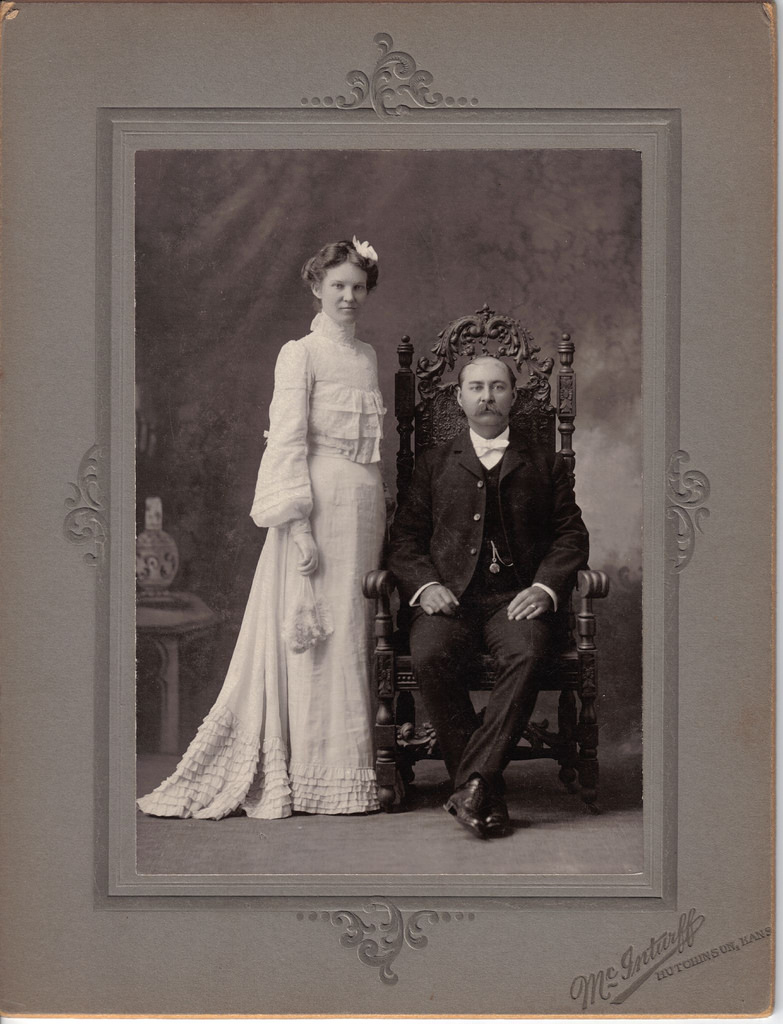
William and Gertie Van Keuren, ~1903
| William Edgar Van Keuren | Gertie May Howard |
| Born June 25,1864 in DuQuoin, Illinois |
Born May 2, 1876 in Mahomet, Illinois |
| Married May 20, 1904 in Hutchinson, Kansas | |
| Died August 25,1950 in Hutchinson, Kansas |
Died October 31, 1963 in Hutchinson, Kansas |
Will's Story
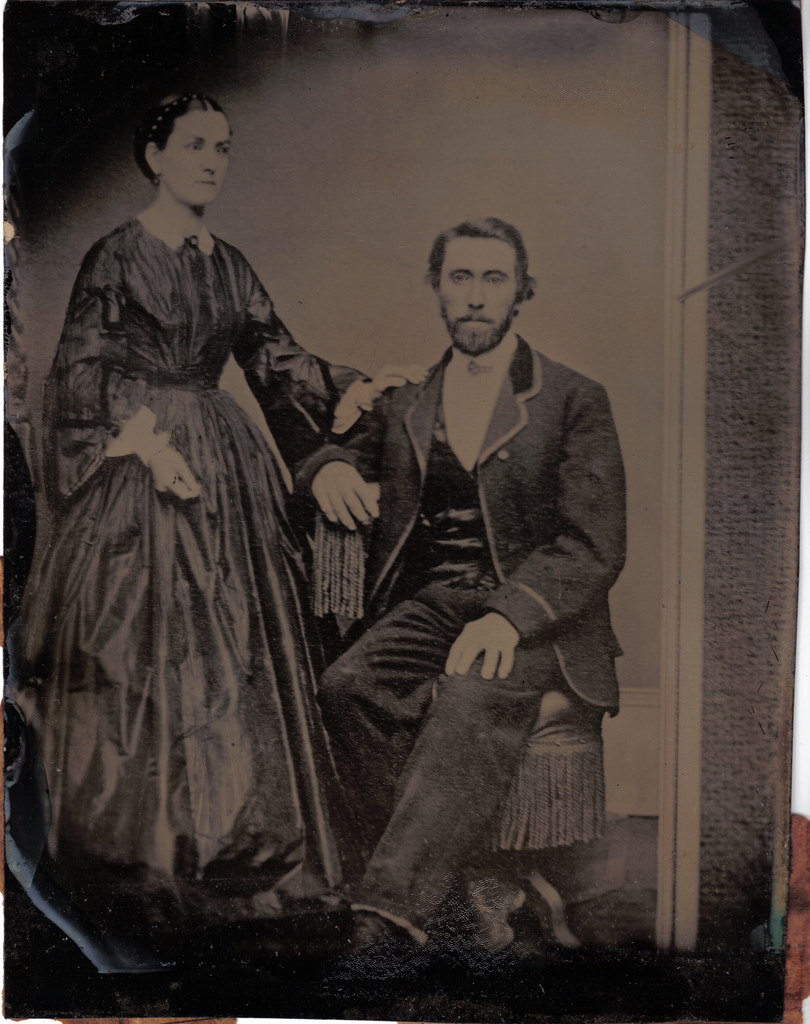
Jacob Van Keuren and Lucy Cooper, ~1857
Because of their mother's ill health, Will and Minnie spent some time with her parents George and Lucy Cooper in Kasson, Minnesota. Will's earliest memory is of the boat ride on the Mississippi River. It was a paddle-wheel boat and quite fascinating to a small boy. Charlie had been kept in DuQuoin, Illinois, as he was in school. Their mother died in 1871 from consumption, or what is now known as tuberculosis. Minnie, a younger sister of Lucy's, had the main care of the children. She married August Anderson, a judge, and they never had children of their own. Each year she sent presents to us for Christmas, birthdays, and Valentines Days. Much to our amusement, Dad was always called Willie.
After the children were home, Jacob wrote to the Minnesota relatives telling them Willie had the measles and they had a woman taking care of them. Jacob married Isabella Onstett in 1872. Her parents lived on a farm near town and Will delighted in playing at Grandpa and Grandma's country home.
Will also liked to play at his father's planing mill. It was strictly forbidden to swim in the large tank at the bottom of a chute, made to catch the logs as they were unloaded. One day Will didn't realize the water was lower than usual. After swimming for some time he found that he could not reach the top of the wall nor climb up the slippery sides. One of the men heard him calling for help and pulled him out-then marched him into his father's office. That ended swimming for all time.
Jacob's health was poor and they found that he, too, had consumption. His health worsened and they decided to move to a climate that might help him. He sold his interest in Powell and Van Keuren Planing and Sash Mill. They came to Kansas in a covered wagon, traveling slowly. After weeks on the trail, they settled in Larned, Kansas. There Jacob built a home for them and did small carpenter jobs. He had money from the sale of the mill so was independent financially.
Larned was growing rapidly, so Will soon had plenty of friends to play with. One thing they liked to do was ride or hike to Pawnee Rock, a mile north of Larned. It was the highest point of land around and had been used by Indian tribes as a lookout point. When the buffalo herds were on the move they traveled by this rock. The boys would lie on top and watch them go by. The herds were so large it would take days for all of them to pass. There were deep ruts made by their hooves and the dust and stench was terrible. Buffalo hunters killed them by the hundreds for the hides, which were very much in demand as robes for travelers and for use in many homes. Buffalo Bill was one of the well known hunters.
Another treat was to go to the Ed Frizzel ranch near town to play. Mr. Ed Frizzel, who was later a state senator, would not allow the buildings left by the Army when Fort Larned was moved to be tom down. Thanks to his foresight, they are now a historical site in Kansas and open to the public.
After Jacob's death on November 11, 1882, in Larned, Isabella returned to make her home with her parents Elihu and Ann Onstett in DuQuoin, Illinois. She later married Judge Parker and remained in DuQuoin the rest of her life. Will and Minnie were enrolled in school there as their father had wished. Charlie had married and did not wish to leave Larned. Minnie was homesick, so she returned to Larned and married Perry Baughman. Jacob was buried in Larned Cemetery and Isabella later had his body moved to DuQuoin and reburied there.
Will was enrolled in the DuQuoin Seminary and lived in a dormitory the first year. The second year he lived in a private home that kept a few students. Will excelled in math and his roommate in English, so they helped each other, vowing eternal friendship as young folks do.
Due to the fact the Jacob and Lucy Van Keuren, and their daughter Minnie Van Keuren Baughman all died from tuberculosis, insurance companies refused to issue life insurance policies for either Will or Charlie. Later Will joined Security Benefit and had insurance with them for the rest of his life. It seems ironic that Will lived past eighty-six and Charlie lived to be over ninety. What a lot of premiums the companies would have collected in those years.
Years later, in about 1936, the Hutchinson paper announced a lecture to be given at McPherson College by an English professor from an Eastern college. My dad said it had to be his old roommate—there couldn't be two of that same name. We drove to McPherson, and as we drove along Main Street we saw a man walking near the curb. Dad said, "Stop and let me out. That's him!" As he stepped up on the curb the man exclaimed, "Will Van Keuren! As I live and breathe!" They had not corresponded for years but recognized each other immediately. They had quite a visit and laughed about one of Dad's favorite stories about "the Pitcher." Their land lady had sent her husband to get a pitcher of milk for dinner. It was the custom to keep butter and milk in the cellar where it was cool. There was a loud crash as he fell down the stairs. She called down to ask if he had broken her glass pitcher. He yelled back, "No, but damned if I don't!" and Bang! went the pitcher. The funny part was that he never allowed swearing among the boys.
In the memos I have is a school report dated November 21, 1885, for Will's fall semester at the Seminary in DuQuoin. Will returned to Larned, as he considered that home. He worked for H. Kling, well known for his handmade boots and other leather articles. Will served as an apprentice there until he qualified as an expert leather worker.
Will and some friends joined the Kansas National Guard. They were not called to active duty and his discharge papers are dated February 1886.
Charlie had moved to Dighton, Kansas, and opened a general store there. Will went to live with Charlie and his family and to help in the store. There is a story of Will being caught in a blizzard and his difficulty in getting back to Dighton with a load of goods.
This story is in a separate article, dictated by Will to "one of his boys" in the KSIR Leather Department. There was a bank robbery in Dighton while Will was there. If I remember correctly, they had warnings that there would be a bank robbery in Dighton. The bank president, Uncle Charlie, and Dad spent several nights in the attic of the store in order to watch the bank. They decided it was a false alarm, and the night after they called of the watch, the bank was robbed. A posse was formed and they caught the robbers after chasing them for more than two days and nights. This was written about in one of the Western Story Magazines my dad loved to read. This was in the late 1930's and the magazine was not saved. As he read many different Westerns I have no idea which one had the article. He enjoyed the stories, for many of them were based on actual facts and people he had known or met. Buffalo Bill, Doc Holiday, Wyatt Earp, and others of the day stayed in Dodge City, not too many miles from Dighton.
Will was an excellent marksman and his favorite sport was skeet shooting. He won many prizes, including second place in the national shoot in Kansas City.
In the spring of 1889 when the Oklahoma Territory, or "Strip", was opened for homesteading, Will and three of his friends decided to go there for fun with no intentions of staking claims. The crowds were camped along the edge of the strip, which was guarded by Army personnel, and kept moving trying to get in better positions for when the starting gun was fired early in the morning. A couple next to them had shared meals with Will and his friends. They had an old wagon with a board for a seat. When the race started they got into rough ground and the wife bounced out. She just sat there and he went on. Each of them filed on a section-the only requirement was that a home had to be built, even a dugout, and occupied for so many months a year. Later, oil was found on much of the land and Dad always hoped they both struck oil on their places.
In 1899, Will accepted a position at Kansas State Industrial Reformatory in Hutchinson. He was in charge of all leather work, making shoes for the inmates, harnesses and saddles. Usually there were from 25 to 30 boys in his department. These boys were given a chance to learn a trade and earn a living for when they were released.
Gertie May's Story
Gertie and her mother came to Kansas by train in 1877. Her father came before them by wagon train to find a location for his family. He first settled in Russell County to homestead. This did not work out and they moved to Emporia, Kansas. There was work there for a stone mason and that was her father's trade. There, her two brothers, Orval and Harry, and two sisters, Ora and Zona, were born. After Zona's birth in 1886 they again moved-this time to Kansas City. Gertie enjoyed life in the big city and attended Oaklen School, which I believe was a small school near the edge of town.
Grandma Howard had asthma and was not in very good health. Gertie, as the oldest, had to take on a large part of caring for the children and help with the housework.
In 1899, Clarence was offered a position as an officer at the Kansas State Industrial Reformatory in Hutchinson. He was to build the wall surrounding the prison. At first Gertie did not like this flat land. She said she felt exposed to the world every time she stepped outside. The family lived on East F Street and Gertie soon joined Hadley Methodist Church on the comer of F and Elm.
Gertie worked in a laundry for a while and became an expert finisher of men's shirts. She and some of her co-workers rode bicycles to work in god weather and the streetcar when weather was bad. These were open cars pulled by horses which ran on tracks and had regular routes.
Most of Gertie's known story takes place after her marriage.
Will and Gertie were married May 20, 1904. It was held at her parents' home and was a big event. She made her wedding dress, and there are samples in their wedding book. Will wore a Prince Albert coat. Soon after their wedding, they bought a home at 541 East B Street and that was their home from then on. Three children were born in the home. Howard was born June 28, 1905, Edgar was born October 22, 1906, and Wilma was born March 5, 1913. Gertie and her sisters had agreed to have the first grandson born named Howard after their dad, Clarence Howard, much to his delight.
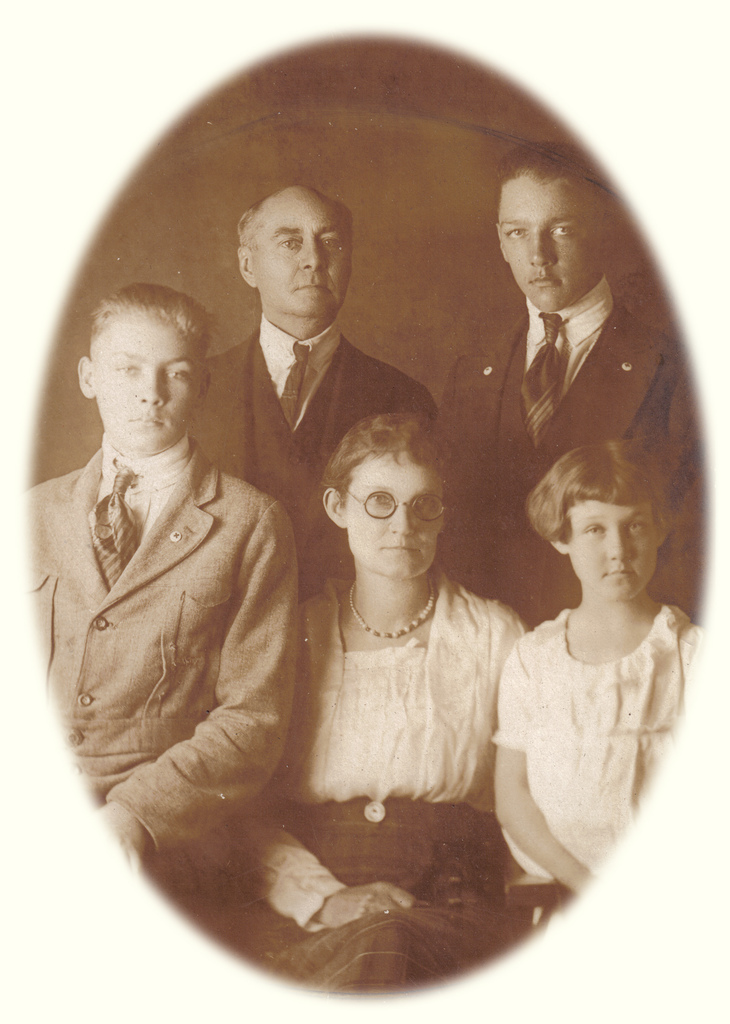
Will and Gertie Van Keuren with Edgar, Howard, and Wilma
In the late 1920's, the church had a small hamburger and pop stand at the State Fair. By 1929, they decided to build a large dining hall and serve regular dinners. A few breakfasts were served to men working at the grounds. This meant opening by six o'clock in the morning and closing late in the afternoon. For a week before the Fair, the women met and canned vegetables, made and dried noodles, and dressed and froze chickens. At fair time, Gertie had charge of the Fairgrounds kitchen and Ma Banks had the kitchen at Hadley. All of the women and some of the men took part. Those at the church made pies by the dozens and helped prepare fresh vegetables for transporting to the fairgrounds. This was the biggest money-making project the church ever had. It was fun to go out and wait on tables on non-school days and then we could roam over the grounds when we were finished.
When the Methodist Church organized W.S.C.S. (Women's Society of Christian Service) in the 1930's, the group met once a month and included women of all ages. The Quilters by this time were all aging but continued to meet three Thursdays a month and quilt. When the first Life Membership and Gold Pin of the W.S.C.S. was given it went to Gertie.
Will had his own shoe shop on Main Street, but after the first World War, times were hard and shoes were shipped in from out of the country. They were sold so cheap that most folks did not have them repaired. So Will returned to the Reformatory in 1925. In addition to shoes he started hand tooling, making billfolds, ladies' purses, belts and briefcases. These were sold to the public and gave the inmates a chance to learn a trade and to help in their employment when they were released from K.S.I.R.
For years Gertie worked in the Sunday School-first with the Cradle Roll, then with the Beginners and then with the Primary Department. After over forty years with the "kids" she moved up stairs and taught her class "The Winners" until her death.
During World War II many men contacted her for proof of their birthdates. Kansas had not registered births until after 1910. She still had the book from Hadley Church in which she had entered so many babies’ births. This was accepted as proof of date of birth and later the book was used to establish proof of age for Social Security Pensions.
Gertie was also active in city affairs. She served on the election boards as head judge most of the time for city and state elections. She also taught sewing classes to underprivileged girls at city hall and was an active member of W.C.T.U. and Charity Workers Club.
In 1937, Will again opened his own shop, this time on West B Street. There was a shortage of qualified men due to World War 11, and Superintendent Roy Frost asked him to again run the leather department. This time, in 1942, he was under Civil Service and was required to take a test each year. My brother was taking a course with the Air Force in California. Dad wrote him that he made 100 on his test and was eighty years old.
Edgar wrote back he had made a 100 also and was only forty, so only had half the time that Dad had to study. Dad would tell this and laugh each time.
Roy Frost had a lot of confidence in Will. The officers worked every other Saturday afternoon. On Sunday all shops were closed, including the leather, tailor, printing, and manual trades. On his weekend to work he was in charge of the reformatory from the gate in front on through the entire building. He wore Badge 1 and I wish we could have kept it.
On Saturday afternoons near the end of the war, 1 would take my young son Jim to the reformatory. I had made him a uniform from one of Edgar's. Dad taught him to salute and everyone got a kick out of this 2½ year old marching along. He was kept busy returning salutes. At that time Will would also take him to the Reformatory for the “works—-a haircut and candy bar—then return to the front, still saluting and never smiling.
After Will's death on August 25, 1950, Gertie continued to keep the family traditions of holiday and birthday get-togethers in her home and this now included in-laws and grandchildren. Both Howard and Edgar preceded their mother in death. Howard, who was the Assistant Chief of the Hutchinson Fire Department, died November 15, 1960, and Edgar died January 28, 1963. Edgar had an aerial spraying service in Montana, and at the time of his death was flying officials on inspections tours of missile bases, employed by Sweeny Airline of Great Falls, Montana. All are buried in Eastside Cemetery in Hutchinson, Kansas.
During my teens there were many visits from relatives-the majority from Mother's side. It was never a large family as some are, but there were uncles, aunts, cousins, second cousins, and even third cousins with whom we had close ties. On Dad's side, Uncle Charlie and family had moved to San Antonio, Texas in the 1920's and usually made a trip every other year to Kansas.
In reading these pages, I wonder how my parents accomplished so much. As busy as my mother was, she found time to make most of my clothes as well as sewing for relatives and friends. She also spent a lot of time caring for my grandmother. A neighbor was always asking either of my parents for advice or help. She made many quilts that have been given to family members.
My parents were very fair and included the in-laws as important members of the family. And how they loved having the grandchildren about and enjoyed being with them and giving them treats, then trading stories and bragging to their friends of the latest "unusually" cute sayings and how smart they were. Though they had a long life together, my parents missed celebrating their 50th wedding anniversary by three years.
One thing I forgot about: The First National Bank was established the day Gertie was born (May 2, 1876). When she called it to their attention, the officers (Meyers and French) saw that she received flowers from the bank on her birthday. On their 75th celebration she received an extra-large one. It was the only bank Will and Gertie did business with and as far as they were concerned it was the Bank.
Gertie was able to live in her home because of her determination to be independent and because she had so many neighbors (some for over 40 years) that checked on her, especially Addie Sealey next door on the East. Addie moved there when she was 12 years old with her parents and shortly after her marriage she and Tip moved back and rebuilt the home. They were neighbors for over 65 years.
Gertie fell while visiting the Matthews family at Palmer Lake, Colorado, injuring her hip. She was in the Memorial Hospital in Colorado Springs for several weeks. I made arrangements to have her flown to Hutchinson. Dr. Brownlee, a friend and semiretired family doctor, said he would care for her. The only time Gertie had flown in a small plane had been with Edgar. She was very uneasy about the trip until she found the pilot knew Edgar-then it was all fine with her.
She was glad to be at home with friends to call on her and many of the Grace Hospital Staff had known her for years. She was never really happy, though, after her two sons had died just a little over a year apart. She never recovered from the fall and its complications, and died October 31, 1963. She is buried next to Dad at Eastside Cemetery just a short distance from her sons.
Bert Billups and Wilma Jane Van Keuren Billups
| Bert Billups | Wilma Van Keuren |
| Born December 15, 1904 in Goodwell, Oklahoma |
Born March 5, 1913 in Hutchinson, Kansas |
| Married March 25, 1934 in Hutchinson, Kansas | |
| Died August 31, 1985 in Nebraska City, Nebraska |
Died May 14, 1999 in Nebraska City, Nebraska |
In this record I have tried to tell some of our history and relate happenings of interest to be remembered and laughed at (for the most part) when you read my accounts. Bert did not have a happy childhood, and I do not know a lot about his childhood but that he was neglected and abused. Mine was an ordinary one for that day and age, and as I look back I led a very happy and carefree life.
Bert's Story
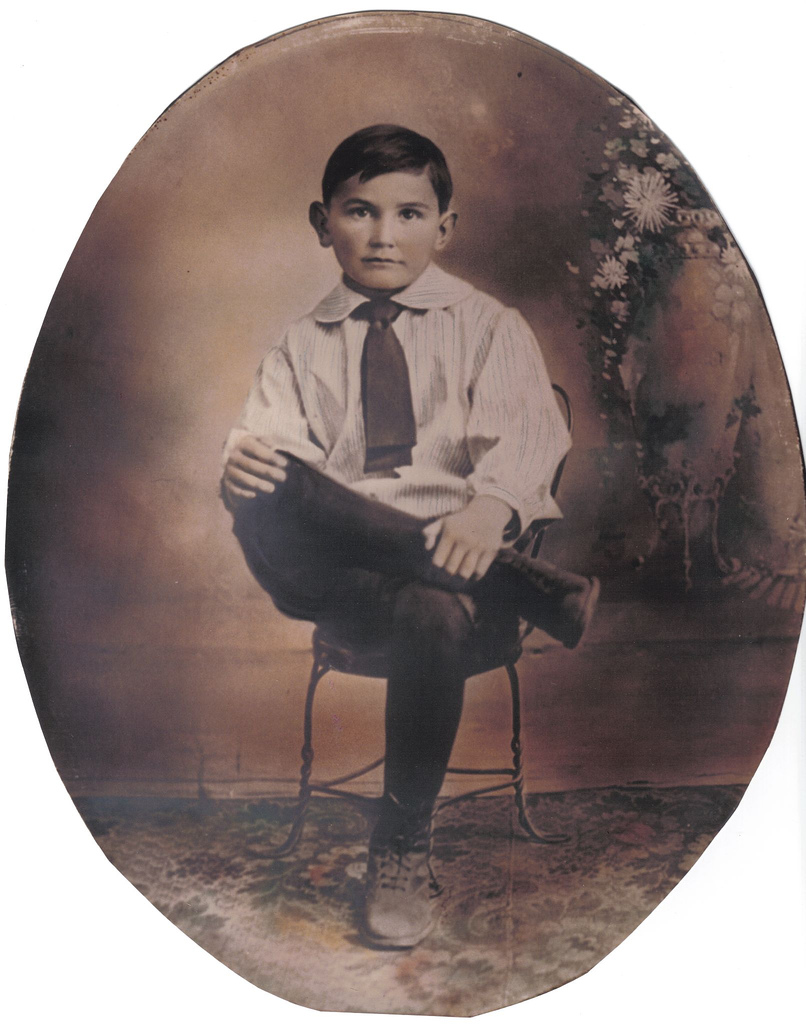
Bert Billups, ~5 years
Bert's mother was Elizabeth Hataway and his father was James Billups.
Bert's earliest memory was leaving his grandfather's home, somewhere in Texas, and going to Oklahoma on the train. His father was a railroad man and his grandfather was a blacksmith. Bert always understood that his grandmother Billups was a Blackfoot Indian. Although Bert did not realize it then, his mother was planning to divorce his father. He said he could remember his grandfather crying as he put him on the train. He and his mother made their home in Guymon, Oklahoma, and his mother sued for divorce.
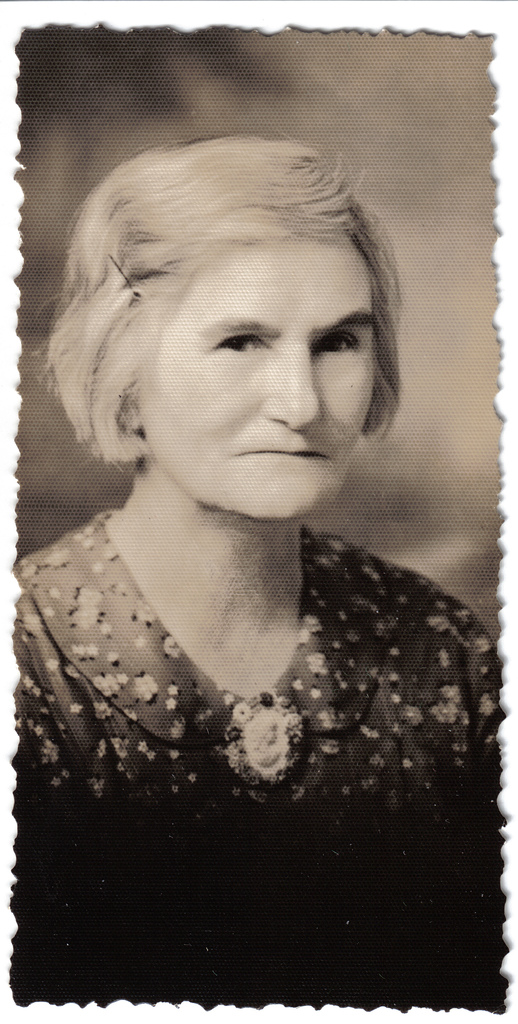
Lizzie Lathrop
Bert's mother worked in Oklahoma for a judge whose wife was very ill. The doctor advised the judge to take her to Colorado at least for the summer to get her away from the heat and dust. Bert's mother was to go with them as nurse and housekeeper. Her health did not improve and they stayed in Colorado until her death late in the fall.
Bert's Aunt Lottie, his mother's sister, was to keep Bert with her family while his mother was away. His mother kept only $5 out of each monthly paycheck and sent the rest to Lottie for Bert's keep. When school started, she used the money to buy her own children's clothes and school supplies, not even buying Bert a pair of shoes. When the snows came he had to wrap his feet in burlap bags and do the chores-not going to school. When his mother returned after the death of her patient and saw the treatment Bert had been given, she took him and moved to her mother and stepfather's farm. Bert always said his Granny Roach was a character and so mean that she ran her husband off. After Bert and I were married, his mother also told me about the time she had to leave Bert and the treatment he received from her sister and family.
Times were hard. Lizzie, as Bert's mother preferred to be called, was unable to find work. Not even housework was available. I never heard Bert complain about his mother, but he never forgave or forgot the treatment from his uncles and aunts. It is hard to believe anyone could be so cruel, but he told me several times of hateful and mean things done to him.
Later Lizzie married Bill Lathrop and they had two sons, Marion and Billy. Bert did not get along well with his stepfather and went to work for his Uncle Tom Hataway, his mother's brother, when he was about twelve. He lived in a one-room shack and "batched." When it stormed, the snow would come through the cracks and cover his bed.
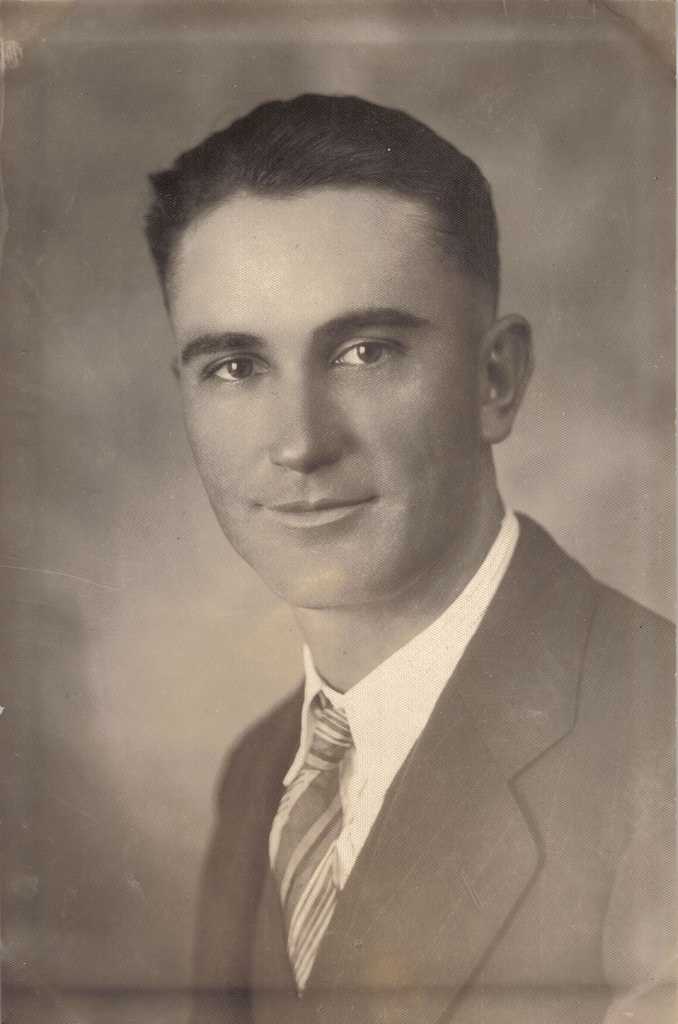
Bert Billups, ~1921
One of the families he worked for was the Rameys—Mrs. Ramey was a sister of Bill Lathrop. They had a son, Glen, and a daughter, Thelma. They were in high school, and Bert would sit at the table after finishing his evening chores and listen to them as they studied. As he said, he got some "learning that way." He had never attended a whole semester of school, because he had always had to help with getting fall crops in and doing the spring planting. I'm telling this because it is remarkable how much he knew of the basic subjects that most of us take for granted. When he was in school for electronics (television and radio), he was able to work complicated algebra problems along with all the others who had at least high school educations.
While in Hooker he learned to fly and was always sorry he was not able to continue on and get his license. He flew an open cockpit plane and still has a picture of himself by the plane.
In 1933, he bought his friends Ward and Alta Mohs to visit the Mohs family near Hutchinson. Rod Mohs, a brother of Ward, lived in Hutchinson and worked at Bond Bakery as the head of the wrapping room. Bert decided to stay and went to work at Bond Bakery in the truck department. Rod offered to share his room with Bert. Rod was dating a friend of mine. He was to get us after a B.Y.P. meeting at the Baptist Church one Sunday evening. When Rod came in for us, he said he had a friend waiting in his car. I asked who he was and what he looked like. Rod said he was short and red headed-a nice guy and new in town. I was self-conscious about being tall so I said I'd go if we didn't go where any of my friends would see me. Imagine my surprise when he got out of the car and I saw he was tall. It was too dark to see him very well and Rod stayed away from the brightly lighted streets so I did not get a good look at him until almost time to go home. Needless to say, I accepted a date the next week. For a long time, Bert told people I wouldn't go with him unless we stayed out of sight of my friends. We dated for over a year and were married March 25, 1934.
The only relatives that Bert kept in touch with (except his mother) were Glen and Zora Ramey of Guymon and Les and Lucille Lathrop of Denver. I never met any of his mother's family until we attended her funeral in Brush, Colorado in 1954.
Wilma's Story
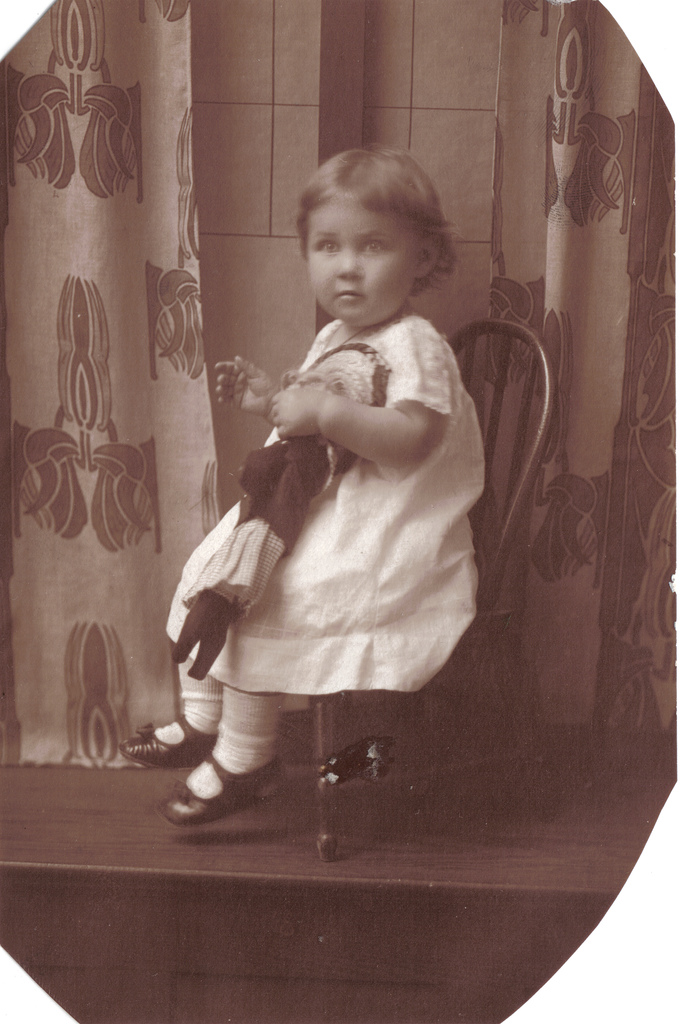
Wilma Van Keuren, ~17 months
My grandparents Clarence and Amanda Howard lived at 620 East C Street, just a little over a block if I went up the alley but about two blocks if I went on the sidewalks. Since I loved to skate, at least half of the time I would run errands to my grandparents' I would choose to skate, going around by the sidewalks. I think I got my first pair of skates for my seventh or eighth birthday. I wore out the wheels and got another pair by the time I was ten.
The neighborhood grocery was a block away at the comer of B and Cleveland. When my mother needed a small item my brothers would bet that I couldn't make it in so many minutes. It was a long time before it dawned on me that I was running all the errands. Then they started betting pennies that I couldn't make the trip in so many minutes. Most of my pennies came from winning the bets.
Another favorite memory is of the horse-drawn ice cream wagon that made daily trips in the summertime. I was given a nickel to buy one each day. I would hurry to eat it an then rush up the alley to Grandpa's to be there when Mr. Eby (the ice cream man) would make a return trip on C Street. It worked fine until Mr. Eby asked why I always got vanilla at my house and strawberry when Grandpa was buying. The grown-ups laughed about it later but it sure put a stop to getting two cones a day.
We had a lot of friends or relatives near us in our part of town. There was much visiting back and forth. Few of us had cars, so we walked almost everywhere except when we rode the street cars. The line came out on East A, so it was only a block to get on. The tracks ran into all parts of town and it was fun to get a transfer and travel from one district to another if necessary. The line went to Hadley Church and was a help in bad weather. These cars were powered by electric lines above the tracks.
We always spent Christmas at my grandparents. As many relatives would be there as possible, the Oklahoma folks corning if the weather allowed them to make the trip. They had an open touring car with side curtains to be used in bad weather. Grandma would heat bricks for them to keep their feet warm. Traveling was slow in those days, so I'm sure the heat did not last more than half' the trip. We continued to meet at my grandparents until after my grandfather's death in 1931.
The Christmas I remember best was when I was four years old. A toy store had a little doll dresser that was all I wanted. It was only a toy about fourteen inches high. After my dad saw it, he made the little dresser twenty-six inches wide and forty inches tall that all of my grandchildren have played with. I kept the drawers filled with toys, dress-up clothes, games, etc. Early on Christmas morning everyone yelled for me to get up and see what Santa had brought. In the two top drawers were candy and nuts. In the large drawer was a doll with leather shoes and in the bottom was a pair of house slippers. I could hardly leave it to go to Grandpa's that year. After I was older, Dad told me he built it at his shoe shop on Main Street and brought it borne on the streetcar. He said he could have sold it, for several women wanted to buy it or have him build one for them. But that was the extent of his carpenter's work, since leather was his specialty. That dresser has always meant so much because it was a labor of love.
All of the above happened before I was old enough to go to school.
There were no kindergartens in the public schools at that time, but a Mrs. Hazel started a private one in the Central Grade School basement. Mrs. Cain picked up five of us children living on A and B Streets. She had a big touring car and it was a thrill to go each day. There were no little girls on B Street, so it was a treat for me. Two of us went on through grade, junior, and high school together.
I went to first grade in Sherman School, which then had classes through eighth grade. There was a cafeteria in the basement and one time when an unexpected storm came, my dad called the principal and asked that Edgar, who was in eighth grade, and I eat at the cafe. He would come by that evening and pay for our meals. Edgar waited for me at the door and told me we were to eat there. He took me to the lunch room and after picking our food had me sit with him and his friends. I was the envy of all the other little girls that didn't have a big brother.
Winans school was built at 800 E. B Street and I attended there from the second grade through the sixth. Then I went back to Sherman, which had become a junior high school, for seventh, eighth, and ninth grades.
Dad's shop on Main Street was next to the Midland Theater. Then, in the days of silent movies, music was played on a pipe organ or piano during the show. When there was a storm in the movie or it called for loud music, it really seemed to thunder—and was loud enough to hear through the walls No wonder my dad never cared for organ music in church—he preferred piano.
Dad closed his shop and went to work at the Reformatory when I was twelve. He was again in charge of the leather department.
While in the second grade, six of us were chosen to be in the "May Fete." I was dressed in a purple crepe-paper costume as a crocus. There was only one negro in our school, Howard Smith, and he was dressed as a sunflower. He was the hit of the show—his little black head and big smile in the flower center.
Every spring the big event was the May Fete held at the Convention Hall in late May. A queen was chosen from the high school senior class. It was considered an honor to be in any of the many dances performed before the winding of the Maypole and crowning of the queen. I was lucky enough to be in all three years, as Liberty Junior High was also included in the limited number chosen. Alas, I was always too tall to get to wind the maypole. The smallest of the class always got to do this. The May Fete was discontinued by the time I started high school.
Lindberg made his famous nonstop flight over the Atlantic Ocean. We danced the Lindy Hop, sang the Lucky Lindy song, and dreamed of the tall hero. Also the Charleston dance became popular with its many steps. I got to relive some of those days when Patricia (my granddaughter) was in a program at her school and needed to know some of the steps.
Tomboy skirts came into fashion when I was in the ninth grade. It was a straight skirt with gores in front-pressed to look like trousers. A boys' white shirt was also a must have item. One Saturday I was in a program for the county teacher meeting at Sherman. After our part was over we were to leave, but six of us decided to watch from the stairway to see the rest of the program. Several of us were sitting on the banister when we saw Mr. Steinheimer (the principal) coming. The rest of the girls ran down the steps and out the door. I whirled around and jumped. There was a pointed post at the foot of the steps and as I jumped I felt my skirt catch on the post. My feet didn't quite reach the floor, so there I hung. Mr. Steinheimer lifted me off and went on without saying a word. It was warm weather and I had to walk home trying to hold the back panel of my skirt up at the waist. Of course I wasn't lucky enough to have a coat with me.
One thing that is hard to believe was the gym outfits we wore. They were big pleated bloomers made of navy blue serge, and were scratchy and hot. There was a band below the knee to make them blouse and resemble a skirt. We also wore a white long sleeved middy louse, long black stockings, and white tennis shoes. By the time we were in the ninth grade, our teacher, Miss Ems, got the school board to approve black pants (below the knee), short-sleeved white blouses, and ankle socks. It was quite an improvement, and we thought we were quite modern.
There was a depression across the country after the Wall Street fiasco of 1929. Many of my friends did not get to go on to high school. We were lucky Dad worked for the state. Looking back, I'm sure lots of my friends had to work to help support their families. Many were hungry, but in those days it was the custom to do without and not ask for relief unless you were desperate.
Hadley Church played a big part in my life. Both of my parents attended regularly and took part in all activities. One of my earliest memories was going to the church on Thursday afternoon to Ladies Aid. One day each month there was a covered dish luncheon. It was a treat, as each woman brought her favorite dish or tried something new. My mother was president for years and the ladies gave me a gold locket. I am wearing it in a picture of me with my mother when I was probably six months old. There are teeth marks in it still, since I used it for a teething ring. There were usually at least five of us girls and one boy that went with our mothers to the church, and after we were older we just went in the summer time. We played an old pump organ in an out-of-the way classroom. I wonder how the ladies stood our music. We'd also get in an old storage room and tell ghost stories. It sounds tame by modem standards, but we thoroughly enjoyed ourselves and looked forward to summer and Thursdays.
Church activities were many, and it seemed that most of my friends and my social life were centered around Hadley. We seldom used the street cars now that we were in high school, as several had cars. We went in groups to games, school plays, and other things. What a mess the tracks were on Main Street when we had parades. All holidays called for parades and no one missed them. Before a football game, there was a parade and big bonfire at the athletic field for junior high, senior high, and later, JUCO college. Our church usually had a winning basketball team and these games were played at the Y.M.CA. It was in junior high that 1 made friends from other schools and in high school from all over town. So besides my friends from Hadley, I had new ones and still keep in touch with them. We enjoy our high school reunions very much.
After graduating from high school I worked at Kresses. I started at the toy counter and then went to the candy counter where being tall was an advantage. The pay was $1.50 per day for a six day week-with no coffee breaks. I started to junior college in the fall of 1933, but quit to get married before the year was up.
Bert and Wilma
Wilma and Bert Billups, ~1934
Bert worked in the auto shop at Bond Bakery. They had a fleet of twenty trucks and three cars. Then came the "dust bowl days". New records in high temperatures were reached. Many days it was 112º and higher. There was a red dust that came sifting down from the sky. It was said to be Oklahoma dirt. It covered everything and seeped through the tiniest cracks. Many tried to keep it out by hanging wet sheets over their windows. The western part of the state was in worse shape than we were, and many lost their farms. There were deaths due to dust pneumonia.
Work was slow and Bert went to work for the Buick Garage in Pratt, Kansas. We had an apartment at the Calbeck Hotel. It was there that I made my famous chocolate cake. I have no idea what happened, but it did not rise as usual. It could be bent without breaking and Bert claimed we had the first synthetic rubber, only didn't know it. It made a good story and for years he delighted in telling it often.
We moved back to Hutchinson and Bert went to work for Bond again. His former boss had been transferred to Tulsa, Oklahoma, and asked that Bert be transferred there. We lived in Tulsa for almost two years. Bert's friends, Ward and Alta Mohs, were living there and I ate my first fried okra in their home.
We moved to Tulsa in March and, of all things, they had the hottest summer on record that year. It was sometimes 115º and 117º for over two weeks. There was no air conditioning in those days, and few had electric fans. Many people slept in the parks to try to catch any little breeze that might come.
We moved back to Hutchinson in 1938, and after a short time Bert was made shop foreman. We had a two room apartment at the folks' and after Linda was born on September 13, 1940, we started looking for a home of our own. We bought the house at 1029 N. Hendricks in January 1941, and after painting and papering we moved in March 1941. This was a three room house without a bath, but it had a garage that we intended to make into a bath and bedroom.
Our first project was to get the bathroom installed. Bert dug a half basement and put in a furnace, hot water tank, and moved the water pump from under the kitchen sink to the basement. There were no switches on the walls, just lights hanging from the center of ceilings. Bert put in wall switches and wall receptacles as well as a porch light. It was lucky for us that Bert had at one time worked in a plumbing shop and could do the plumbing and electric work.
We had about given up on having children before Linda was born six and a half years after we were married. Then we were fortunate enough to have Jim on August 3, 1943, and Kenny on January 1, 1946.
Bert finished the new bedroom in time for us to move Jim and Linda into it. Also, he built a back porch and enclosed it so I could have the washing machine there. He even ran both hot and cold water pipes, so there was no more carrying the water from the kitchen. Later, we added a third bedroom off the porch.
While Kenny was still too young to be in school, Bert's health failed. After seeing doctors in Hutchinson with no success, he went to the Halstead Clinic. After many tests there and an examination by a lung specialist from New York, he was told that his lungs were affected by the exhaust fumes from the trucks and that he should get out of that work immediately, since his lungs were so raw he was lucky not to have tuberculosis. In those days there was no leave of absence from your job, so Bert was on his own. He tried doing repair work in our garage and piping the fumes out, but he didn't get better.
Francis Fox started a bus line and hired Bert to keep his buses going. Most of the time he worked in the open, as the buses were too large to get inside, but this only lasted a short time. This was while the Naval Air Base was located south of Hutchinson. One bus line came to our comer, Eleventh and Hendricks. Several afternoons a week we'd take our kids, get on the bus, and make the round trip. Since gas was rationed, it gave us a chance to get away from home.
A neighbor, Claud Jury, asked if Bert would be interested in helping him farm his mother's farm near Ulysses, Kansas. Bert had made the wheat harvest with Les Howard and had been gone for three months. We thought that this might be a good idea. For several years we went to the farm in the summer months, living in a small house on the farm. Bert and Claud would go in the fall and spring to do the planting and harvest corn in the fall. So we had a little taste of pioneering-no bath or running water. There was a small light plant run by a gasoline engine; it furnished us with enough power for lights and to iron. The windmill was near the highway. We had large milk cans that we filled and brought to the house in a truck.
This wasn't a very satisfactory way of life, and not too profitable either. Bert decided to make a big change. He enrolled in the Electronics division of the Wichita Business School. He started in September and graduated in March 1955 with a degree in TV and Radio Repair. For over a year, he was shop foreman of the Ford Tractor Shop and did TV work at night. Finally, he was able to have his own shop full time. He often said that he enjoyed electronics better than any other trade he had worked at. His shop was known as "Bert's TV and Radio Repair."
The first break in my family was my father's death on August 25, 1950. He was buried in Eastside Cemetery in Hutchinson, Kansas. My mother continued to keep the family home and have family gatherings at holidays and birthdays. Dad had seldom been sick and, until his heart attack, had not been in a hospital. Many of the neighbors had lived in that neighborhood for years. Next door was Mrs. Crouch and her daughter, Addie, who later married and she and Tip Sealey continued to live there. So Addie and my mother were neighbors for years.
We didn't get to take many vacation trips. One I'm sure we all remember was a visit to Grandma Lathrop in Brush, Colorado. We had fried chicken and garden fresh vegetables every day. Les and Lucille Lathrop came to spend a day with us and invited us to visit them in Denver. What fun we had! They lived in a trailer house. Les took a day off and went to Tiny Town in the mountains. Everything was child-size-the trains, the rides, etc. We toured many sights. I don't remember the exact year, but Jim and Kenny slept on an army cot—heads at one end and feet in the middle. They must have been very young.
Mom Lathrop died in 1956. She had retired for the night and had a massive heart attack. Bill Lathrop had gone to California for a visit. Her doctor, knowing she was alone, stopped to check on her and found her sitting on the side of her bed. Evidently she had not even laid down. We went to the funeral held in the Baptist Church and she was buried in Brush, Colorado.
We started the biggest project of all on our house in 1959. It was a family room that completely changed our house. Bert did most of the work with help from the boys. I had a completely remodeled kitchen and the most modem of cabinets and appliances. Later we remodeled the bathroom, adding a shower. Bert really did professional looking work.
There had been no deaths in our family since my father's death in 1950 and Bert's mother in 1956. There were so many changes in the next few years.
Jim joined the Army in the fall of 1961. He took his basic training at Fort Carson, Colorado. He was stationed at Fort Sill, Oklahoma, and from there he was sent to Germany. He was seriously injured while there and brought to Fitzsimmons Army Hospital in Aurora, Colorado.
My brother Howard had to retire from his position as Assistant Chief of the Hutchinson Fire Department after suffering a massive heart attack while on duty. He later drove the traveling library truck for the city. He enjoyed seeing all the school children when he delivered the books. He had a fatal attack on November 15, 1961, and was buried in Eastside Cemetery, Hutchinson, Kansas.
Linda married Galen Pinkerton in February 1962.
My brother Edgar died unexpectedly in January 1963. At the time, he was a pilot for Sweeney Airline in Great Falls, Montana. He was flying engineers to inspect the missile bases located in Montana, South Dakota, and Wyoming. Edgar died in Cheyenne, Wyoming and is buried in Eastside Cemetery.
Mother died in Hutchinson on October 31, 1963. She fell while visiting in Colorado, breaking her hip and never fully recovering. We visited Jim at Fitzsimmons and then went to Palmer Lake to see Oscar Matthews. He was a retired Methodist minister and they had asked mother to visit them for a long time. I came home and she was to visit for a week. She fell as they were leaving church and was in the hospital at Colorado Springs. I went there to be with her and decided to bring her home. She had to have a nurse with her, so I chartered a small plane and drove home. She wasn't happy to be flying without me along. I had given my name to pilot but he heard the nurse call Mother Mrs. Van Keuren. He asked if she was Ed's mother and when she found that he had known Edgar she was perfectly happy to fly with him. Mother died at Grace Hospital on October 3 1, 1963. She was buried in Eastside Cemetery. Jim was able to come home for her funeral—on crutches. Later he was transferred to Fort Sill to finish his enlistment.
All three children attended North Reno County School through the eighth grade. Linda graduated from Hutchinson Senior High. Jim and Kenny both chose Nickerson Community High School and graduated from there.
When Jim came home from the Army, he and Kenny both enrolled at Hutchinson Junior College. After graduating from there, Jim went on to K-State at Manhattan to study veterinary medicine and receive his D.V.M. Kenny went to Hays State Teacher College and received his degree there.
Linda had a daughter May 25, 1967 and named her Patricia May (for my mother Gertie May). After her divorce in January 1970, she and Patricia returned to Hutchinson, where Linda enrolled in Hutchinson Junior College. After graduating from there, she went to Wichita State University and graduated with a degree in Business Administration with an emphasis in accounting and marketing.
Ken married Linda Caraway on November 22, 1969, shortly before leaving for duty with the Army in Viet-Nam. On returning, he entered Washburn University at Topeka, Kansas, and received his degree in law. Laurie, his first daughter, was born in Salina, Kansas in 1974, and daughter Lisa was born in Warner Robbins, Georgia, in 1977.
From now on I will refer to our daughter Linda Joan as Linda J., and Kenny's Linda as Linda.
Jim and Susan Kerr were married on August 16, 1970, in Wichita, Kansas. Both were attending K-State when they married. They graduated from Kansas State University the same year. Jim practiced as a D.V.M. in Sioux Falls, South Dakota, where they adopted Derek, almost five years old. Susan worked with the Indians over the entire state. They moved to Nebraska City, Nebraska, so Jim could practice veterinary medicine, and Joy was born in 1974. Jim decided to enter the University of Nebraska Medical Center and received his M.D. there. Wes was born in 1976, and Stephanie was born in 1979 while Jim was still in training. They decided to make their home in Nebraska City, and Jim continued to practice at Midlands Hospital in Omaha. Now, as of 1992, he is on the staff of three hospitals in Lincoln.
Bert and Wilma Billups
We sold our home and moved to Nebraska City to be near Jim and his family. Bert felt Jim would tell him what his diagnoses were in language he could understand. He was right, and we knew Bert would get the best of care.
We moved the last of June, 1982. What a time we had! We held garage sales, and still had so very much. The accumulation of over forty years. Susan came down for a week and helped us to pack. I don't believe I would have ever managed alone.
Kenny came from Wakeeny, Kansas, in the biggest truck he could rent from U-Haul, and we used it, Jim's truck and horse trailer, and both cars, all fully loaded. Everything was jammed to the brim. We looked like the Okies in the Grapes of Wrath when we pulled out.
Linda J. came over and Jack Anderson and Harold Might, my cousins, were all there to wave us off, as well as our neighbors, June and Marguerite Pieplow. It was the last time we were to see June, as he died soon after we moved. They had been our neighbors for almost twenty-five years.
By evening we were settled in our new home, Apt. 2, 1319 Tenth Avenue, Nebraska City. All furniture was in place, the bed was made, and the Mr. Coffee was ready to turn on. Susan even had new paper in the cabinets. There were still some dishes to unpack and things to be stored in a barn at the farm. It was an excellent moving job, with nothing broken or scratched. In October, we moved into Apartment 1, so our car could be parked near our back door, where it was easier for Bert to reach the car with his walker, and later, a wheelchair. This apartment also had a wood-burning fireplace, to my delight.
Bert never regretted our move and enjoyed visiting the farm. He liked to park near the river and watch the barges move up and down. We were never lucky enough to see them load or unload their cargos. Another treat was going to Brownville with Susan and children and taking a ride on the river boat. It was something Bert had never done before. Not once did he ever say he missed his shop or work. His health deteriorated and he had to be in a nursing home in the last year of his life. He died August 31, 1985, and is buried in Eastside Cemetery in Hutchinson, near the in-laws he loved so much.
Kenny and his family moved to Peru, Nebraska, shortly after we moved to Nebraska City. After Bert's death, they moved to Pueblo, Colorado, where he has a law practice in partnership with Mickey Smith.
Linda J. and Patricia were in Wichita and came to visit a couple of times each year. After Linda J. had been with Boeing for over nine years, she decided to make a change. First she went to Fredonia, Kansas, to try to establish a bookstore. After this did not work out satisfactorily, she moved to Coffeeville, Kansas. Patricia stayed in Wichita and graduated from Wichita University in 1990.
This had become quite a long story, but it would not be complete if my grandchildren were not included.
While in Hutchinson we looked forward to having the older girls visit us and go the Bible School for several summers. Patricia taught and Joy and Laurie went to classes at Mitchel Chapel. The last year, Lisa came too, although she was not old enough for school. What good times we had. One year, someone brought water pistols. Laurie and Joy were having so much fun chasing each other around the house that Bert decided to get in on the fun. He was using the garden hose and just as I came around the comer of the house he turned it on me. Much to everyone's delight I was really soaked. We never got to have Wes and Stephanie come for a visit. I am sure they would have had fun too, and I know we would have.
Our middle bedroom was quite small, so I had a single bed with a trundle bed underneath. Bert would always tell the grandchildren there was only one bed-then the arguments would start. The kids insisted there was a magic bed and he could see it later. When they were ready for bed, they'd call him in to see they had a real bed. Much to their amusement, Bert would shake his head and keep insisting they really had him fooled.
Bert's favorite cookie was a coffee cookie. I always kept some on hand. I don't think the grandchildren liked them as well, but when Bert would come in to drink coffee and eat cookies, they delighted in getting to the cookies first. There were some good arguments as to just who the cookies belonged to, and all seemed to enjoy them more after some discussions and laughter. The cookies seemed to taste sweeter if they could snitch them before their granddad grabbed them.
I have to also tell one of my favorite stories of Mom Lathrop. She had been in the hospital and had some blood transfusions not long before coming to see us. She had an unusual type of blood, and the town drunk was the only match in their small town. He had to be sobered up before they could make the transfusion. While she was visiting us, she was a little unsteady in her walk. One time she looked at me, and with a twinkle in her eyes said, "I wonder if they really sobered him up before I got those transfusions."
Linda J. is now an accountant with Medicalodges, Inc. in Coffeyville, Kansas. She has lived there for over a year and prefers living in a small town. For 9½ years she was with Boeing Airplane Company in Wichita as an accountant in the Finance Department.
Patricia is studying for her master's in English at New York City College. She graduated from Wichita State University in 1990 with a degree in English and Philosophy.
At the present, Jim is with the three hospitals in Lincoln: Bryan Memorial, Lincoln General, and St. Elizabeth's. Susan and a friend have an auctioneering company and handle estate auctions consisting of many antiques. Their Simmental cattle business keeps them all busy and they have won many prizes.
Joy graduated with honors in the spring of 1991 from Nebraska City High School. She attends the University of Nebraska-Lincoln on a four year scholarship. Wes and Stephanie are happy in the city schools. All of them took the lower grades in a little red schoolhouse just up the road from their country home.
Kenny, Linda, Laurie, and Lisa are very happy in their home in Pueblo, Colorado. Besides his law office, Kenny teaches a class at the University of Southern Colorado in Pueblo. Linda is busy with the New Comers Club work. She is in charge of craft classes and finds new projects for the women each month. Laurie and Lisa both enjoy their schools and like being in Colorado. Laurie works one afternoon each week after school in her dad's office.
Bert and I celebrated our 50th wedding anniversary on March 25, 1984, in our home. I still have the 50th decorations from our cake. Since we knew very few people and Bert was not well, we had a quiet party in our home with Jim, Kenny, and their families to celebrate with us.
In the past five years I have taken an active part in the Presbyterian Church Women's Group. I also joined the American Legion Auxiliary and the Eagles Auxiliary and enjoy meeting my friends several times a month to have lunch and visit. I have been President of the Federated Women's Club here in Nebraska City, and for the most part enjoy it although it sometimes is a lot of work. I have made some good friends through the work. Last year, we received a reward as the oldest Federated Club in Nebraska—"100 Years". I also try to take an active part in Questers and find the meetings fascinating. So I keep busy and manage to make a trip home on Memorial Day (also join Linda J. and Patricia then), and I make at least one trip to Pueblo a year. I plan for this to be my home from now on-unless I change my mind, as is always a woman's privilege.
One of the joys of being parents is getting to have grandchildren to bring pleasure when your children are grown and in their own homes. How happy the holiday seasons are then!
—Wilma Jane Van Keuren
Billups,
Nebraska City, Nebraska, 1992